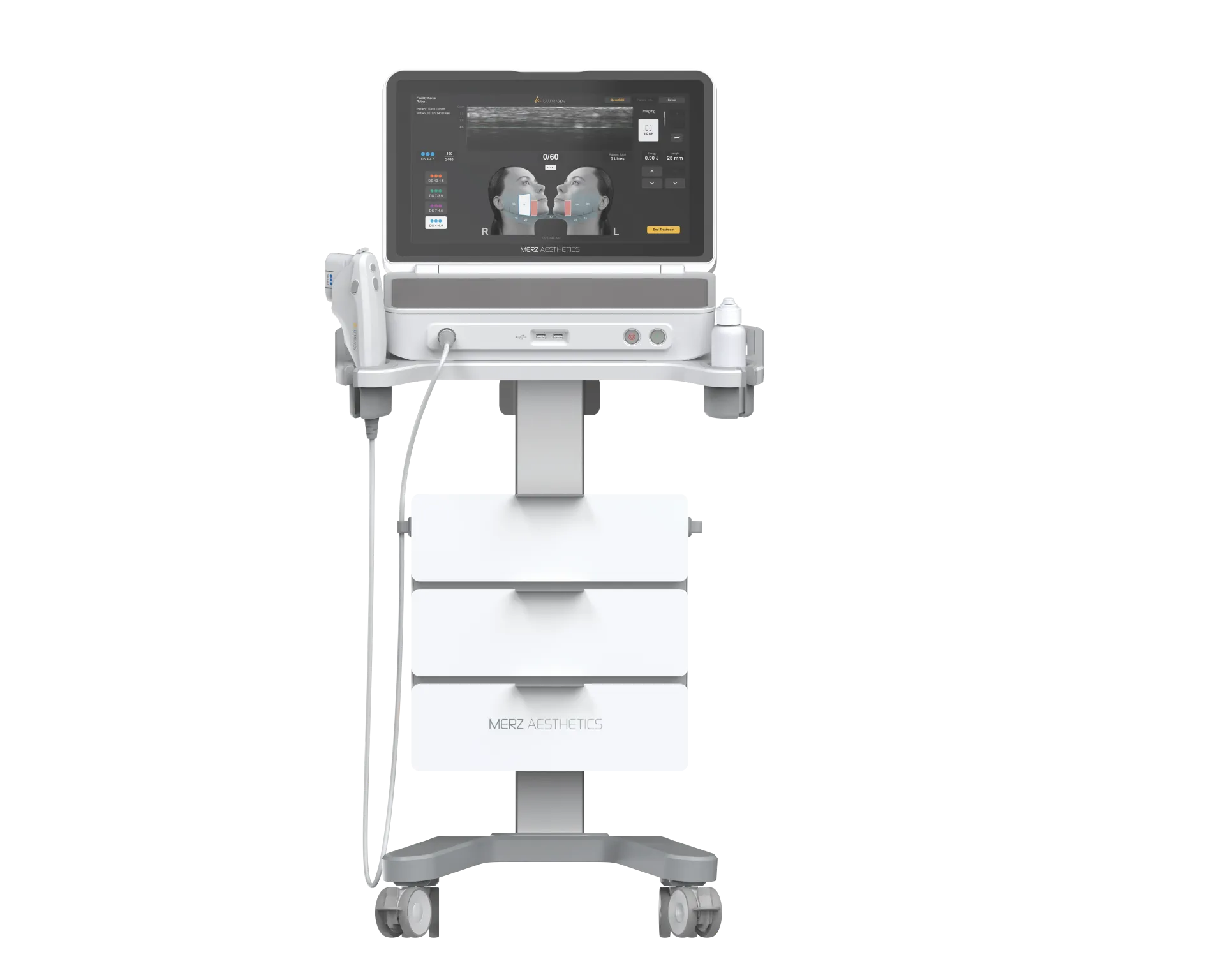
FDA and KFDA Clearance Status
Ultherapy received US FDA 510(k) clearance in September 2009 for non-invasive lifting of the eyebrow. Subsequent clearances expanded indications to include the submentum (under-chin) and neck in 2012, and the decolletage in 2014. The Korean Ministry of Food and Drug Safety (MFDS, formerly KFDA) approved the device under its Class III medical device classification. Ultherapy Prime, the latest-generation platform, uses updated transducers operating at 4MHz and 7MHz frequencies to deliver micro-focused ultrasound at 3 precise tissue depths: 1.5mm, 3.0mm, and 4.5mm.
The FDA clearance distinguishes Ultherapy from uncleared HIFU devices available in some Asian markets. Only Ultherapy carries the specific FDA indication for non-invasive tissue lifting. Patients should verify that their clinic uses the genuine Merz Ultherapy system, identifiable by its DeepSEE ultrasound visualization screen that displays real tissue layers during treatment. Suh DH et al. Clin Cosmet Investig Dermatol. 2015;8:223-228. doi:10.2147/ccid.s78006
Common Side Effects and Their Duration
Temporary side effects occur in most patients and resolve without intervention. Redness at the treatment site appears immediately and fades within 1-3 hours for 85% of patients. Mild swelling peaks at 24-48 hours and subsides by 72 hours. Tenderness to touch in treated areas lasts 1-2 weeks in approximately 30% of patients. Small areas of bruising may appear in 5-10% of treatments, particularly along the jawline and neck where the skin is thinner.
Transient Nerve Effects
Temporary numbness or tingling affects roughly 2-3% of patients, typically resolving within 2-6 weeks. This occurs when ultrasound energy is delivered near superficial nerve branches. Experienced practitioners minimize this risk by using the DeepSEE visualization to identify and avoid nerve-dense areas. A published review of 4,402 treatments found motor nerve weakness in 0.06% of cases, all of which resolved completely within 8 weeks. MacGregor JL et al. Dermatol Surg. 2014;40(5):573-579. doi:10.1111/dsu.12472
Contraindications and Pre-Treatment Screening
Absolute contraindications include active skin infections or open wounds at the treatment site, metal implants (plates, screws, or stents) in the target area, and cystic acne directly on the treatment zone. Pregnancy and breastfeeding are standard exclusion criteria. Patients with a history of keloid scarring require careful assessment, as any treatment that stimulates collagen production carries a theoretical risk of triggering keloid formation in predisposed individuals.
Medication and Condition Considerations
Blood-thinning medications including aspirin, ibuprofen, and prescription anticoagulants increase bruising risk but are not absolute contraindications. Patients taking isotretinoin (Accutane) should wait 6 months after discontinuation before undergoing Ultherapy Prime. Those with autoimmune conditions such as lupus or scleroderma require physician clearance. A thorough pre-treatment questionnaire screening 12-15 risk factors is standard protocol at Korean clinics.
Safety Protocols at Korean Clinics
Korean aesthetic clinics follow a structured safety protocol for Ultherapy Prime procedures. Pre-treatment ultrasound imaging maps the tissue layers, identifying the SMAS at 4.5mm depth where maximum lifting occurs. The practitioner adjusts energy levels across 3 depth settings based on tissue thickness, which varies between facial zones. Real-time visualization during delivery confirms that energy reaches the intended target without affecting surrounding structures.
RE:BERRY clinics maintain their Ultherapy Prime devices under manufacturer-certified maintenance schedules, with transducer replacement at manufacturer-specified intervals. Aesthetic Medicine Specialist Yoon-Gon Ryu applies individualized energy mapping that accounts for each patient's tissue depth variation across treatment zones, reducing the likelihood of undertreated or overtreated areas.
Long-Term Safety Profile
Ultherapy has accumulated over 15 years of post-market safety data since its 2009 FDA clearance. No long-term adverse effects have been documented in peer-reviewed literature. The ultrasound energy creates thermal coagulation points at controlled depths without disrupting the skin surface, meaning the epidermis remains intact throughout treatment. Collagen remodeling triggered by the procedure follows the body's natural wound-healing cascade over 2-3 months.
Repeat treatments are considered safe, with most patients undergoing 1-2 sessions per year. A 5-year longitudinal study tracking 93 patients receiving annual Ultherapy treatments reported no cumulative adverse effects and sustained improvement in skin laxity measurements. The thermal coagulation points created during each session heal completely within 6-8 weeks, leaving no permanent structural changes other than new collagen and elastin deposition.